 Traditionally, "ECG" usually means a 12-lead ECG taken while lying down as discussed below. However, other devices can record the electrical activity of the heart such as a Holter monitor but also some models of smartwatch are capable of recording an ECG.
 An electrocardiogram (EKG or ECG) is a diagnostic tool that records your heart’s electrical activity. Healthcare providers use it for many reasons, like to diagnose heart rhythm issues or to monitor how well a treatment is working.
 ECG Basics including Rate, Rhythm, Axis calculations and interpretation of P, Q, R, S, T U waves, segments and basic ECG calculations
 ECG is the abbreviated term for an electrocardiogram. It is used to record the electrical activity of the heart from different angles to both identify and locate pathology. Electrodes are placed on different parts of a patient’s limbs and chest to record the electrical activity.
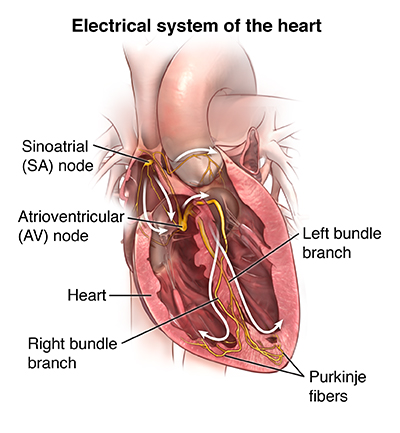 An electrocardiogram (ECG or EKG) is one of the simplest and fastest tests used to evaluate the heart. Electrodes (small, plastic patches that stick to the skin) are placed at certain spots on the chest, arms, and legs.
 Electrocardiogram, ECG, or EKG, is a diagnostic tool that measures and records the electrical activity of the heart. Learn about what conditions can be diagnosed through this test.
 An electrocardiogram (ECG or EKG) is a painless, non invasive test that uses electrodes on the skin to measure these small electrical changes and produces a graph showing the electrical changes over a period of time.
 What is an electrocardiogram (EKG) test? An electrocardiogram (EKG) test is a simple, painless, and quick test that records your heart's electrical activity. Each time your heart beats, an electrical signal travels through your heart.