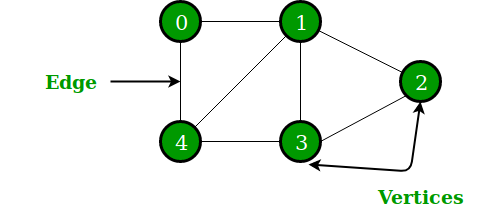
Graph is a non-linear datastructure like tree data structure. The limitation of tree is, it can only represent hierarchical data. For situations where nodes or vertices are randomly connected with each other other, we use Graph.
Below are short introductions of the different Graph representations, but Adjacency Matrix is the representation we will use for Graphs moving forward in this tutorial, as it is easy to understand and implement, and works in all cases relevant for this tutorial.
What is a Graph? A graph is an abstract data type (ADT) which consists of a set of objects that are connected to each other via links. The interconnected objects are represented by points termed as vertices, and the links that connect the vertices are called edges.
Understand GraphDataStructure, its types, uses, examples, and algorithms in this tutorial. Learn how to implement and optimize graph-based solutions here.
A graphdatastructure consists of a finite (and possibly mutable) set of vertices (also called nodes or points), together with a set of unordered pairs of these vertices for an undirected graph or a set of ordered pairs for a directed graph.
What Are Graphs in DataStructure? Graphsindatastructures are non-linear data structures made up of a finite number of nodes or vertices and the edges that connect them.
Formally, a graph G is defined as a pair (V, E), where V represents the set of vertices or nodes, and E represents the set of edges connecting these nodes. In computer science and mathematics, the graphdatastructure stands as a fundamental concept with far-reaching applications.
GraphDataStructure is a collection of nodes connected by edges. It's used to represent relationships between different entities. If you are looking for topic-wise list of problems on different topics like DFS, BFS, Topological Sort, Shortest Path, etc., please refer to Graph Algorithms. Video Player is loading. This is a modal window.
In this article, you'll explore everything from fundamental concepts to hands-on examples and advanced algorithms. In this blog, we'll dive deep into the graphdatastructure —understanding key concepts, types of graphs, and their real-world applications.